Looking at the East Africa Safari Highlights for 2026/27
East Africa remains the benchmark against which every other safari destination is measured. Kenya, Tanzania, Uganda, and Rwanda sit almost exactly on the equator, which means the region runs on rainfall rather than temperature, and that rainfall drives one of the most extraordinary cycles of animal movement on the planet.
Also Read: Why Battle Ground WA Roofs Fail Early & Prevention
For 2026/27, the headline draws remain the wildebeest migration, the Big Five plains of the Serengeti-Mara ecosystem, gorilla trekking in the misty Virunga forests, and the chance to combine it all with a few days on an Indian Ocean beach. What’s worth knowing going into the new season is how timing, pricing, and booking windows are shaping up.
Why East Africa, and Why Now
Unlike Southern Africa, which has a single wet and dry season, East Africa sits beneath the Inter-Tropical Convergence Zone, a band of rain that sweeps over the region twice a year as it follows the sun. This produces two dry seasons (roughly June to October, and January to February) and two wet seasons (the “long rains” of March to May, and the “short rains” of November to December). Daytime temperatures barely shift across the year, hovering between 25–30°C in most safari country, so the real planning question isn’t “will it be hot” but “will it be dry, and where will the animals be.”
That rainfall pattern is also what drives the single biggest reason people book an East African safari in the first place: the Great Migration.
The Great Migration: Still the Main Event
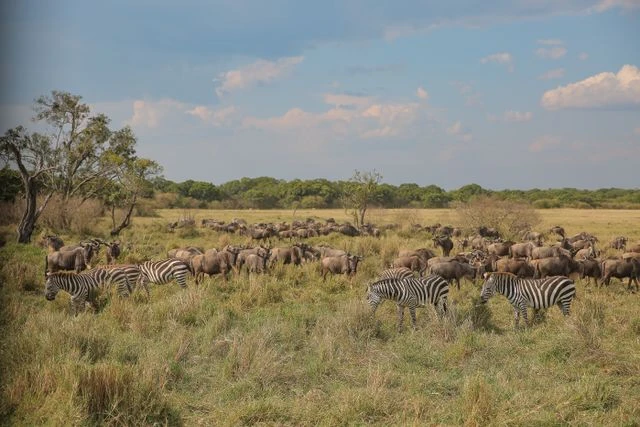
Roughly 1.5 million wildebeest, alongside several hundred thousand zebra and gazelle, move in a continuous, clockwise loop of around 800km through the Serengeti-Mara ecosystem, chasing fresh grass and water. It’s a year-round phenomenon, but it has distinct phases that determine where you should be and when.
January to March — Calving season, Southern Serengeti and Ndutu Plains (Tanzania). This is an underrated window. An estimated 8,000 calves are born daily over a three-week peak, which in turn draws in lions, cheetahs, and hyenas for some of the most intense predator action of the year. Crowds are lighter than the July–September peak, and February in particular has become popular precisely because it combines calving drama with good weather.
April to June — Long rains and the move north. The herds drift north-west through the central Serengeti as the southern plains dry out. This is the cheapest and quietest time to travel, with lodge rates often 20–40% below peak. Roads can be muddy and game drives less predictable, but it suits photographers and budget-conscious travelers who don’t mind a gamble.
July to October — The Kenya Window: river crossings. This is the marquee event. As the southern Serengeti dries out, the herds funnel north into Kenya’s Masai Mara, crossing the Grumeti River first, then facing the famous, crocodile-infested Mara River. For 2026, forecasters are pointing to the “mega herds” being established in the Mara by the third week of July, with August expected to be the peak of the peak in terms of sheer animal density. Operators anticipate the historical late-July-to-early-October window holding for 2026, with peak crossing activity most likely in August and September.
A few practical points worth knowing if a river crossing is the goal:
- Wildebeest entering Kenya actually cross three rivers in sequence — the Sand River first, then the Talek, and finally the Mara — but only the Mara River delivers the genuine crocodile drama; the other two are shallow and comparatively unspectacular.
- Crossings are never guaranteed on any single day. Most operators recommend budgeting at least four days in the Mara to give yourself a realistic chance of seeing one.
- Park fees during migration season run around USD 200 per person per day, and that entry expires at a fixed time each evening regardless of what you saw.
- Crowding is real. Popular crossing points can draw upwards of a hundred vehicles at once. Staying in a private conservancy bordering the reserve (Mara North, Olare Motorogi, and similar) costs more but allows off-road driving and far fewer vehicles competing for the same view.
November to December — The return south. Triggered by the short rains, the herds begin moving back into Tanzania. Predator activity stays high through this period as animals fatten up before the journey, and game viewing benefits from noticeably thinner crowds than August, making it a good option for serious photographers who’d rather skip the convoy of safari vehicles.
For 2026/27 bookings, the message from virtually every operator is consistent: camps along the Mara River and in northern Serengeti for August/September sell out 10 to 18 months ahead. If a river crossing is the priority, booking should already be underway for July–September 2026, and travelers eyeing 2027 should be getting itineraries locked in well before the end of 2026.
Kenya Beyond the Mara
The Masai Mara understandably gets the headlines, but Kenya’s other parks are worth building into an itinerary, especially outside peak migration months when the Mara is crowded.
Amboseli National Park is the classic postcard shot — large elephant herds grazing with Mount Kilimanjaro looming in the background across the Tanzanian border. It’s compact, easy to combine with the Mara, and reliably good even in shoulder months.
Laikipia Plateau has become one of the more interesting additions to Kenyan itineraries for travelers who’ve done a “first” safari already. It’s a conservancy-led landscape rather than a national park, which means night drives, walking safaris, and horseback safaris are possible, plus strong rhino and wild dog populations.
Lake Nakuru and the Rift Valley lakes are worth a stop for flamingo concentrations and rhino sanctuaries, particularly if travelling with people who want variety beyond plains game.
Tanzania: Serengeti, Ngorongoro, and the Quiet Giants
Tanzania holds the lion’s share of the migration’s range and adds two destinations that don’t depend on the herds at all.
Ngorongoro Crater is a self-contained ecosystem inside a collapsed volcanic caldera, with one of the highest densities of predators anywhere in Africa packed into a relatively small area. It’s a reliable, near-guaranteed Big Five sighting location regardless of season, which makes it valuable as an anchor for an itinerary built around uncertain migration timing.
Tarangire National Park, with its baobab-studded landscape and large elephant herds, is often underrated next to its famous neighbors but offers excellent dry-season game viewing with a fraction of the crowds.
Northern Serengeti (Kogatende, Lamai Triangle) is the Tanzanian side of the river-crossing drama and, for travellers who want the spectacle with more breathing room than the Kenyan side typically offers, is increasingly recommended by operators as the calmer alternative for July–September.
Tanzania safaris pair naturally with Zanzibar, a short flight from Arusha or the northern parks, for a beach extension — by far the most common way travellers close out a Tanzania itinerary.
Uganda and Rwanda: Gorillas, and a Genuinely Different Safari
If the savannah migration is the headline act, mountain gorilla trekking is the other unmissable East African experience, and it sits entirely outside the migration calendar, making it easy to combine with a Kenya or Tanzania trip.
Mountain gorillas exist in only two places on Earth open to tourism: Uganda’s Bwindi Impenetrable National Park (and the smaller Mgahinga Gorilla National Park), and Rwanda’s Volcanoes National Park, both part of the wider Virunga Massif shared with the Democratic Republic of Congo.
Cost is the major differentiator between the two countries for 2026/27. Uganda charges international visitors USD 800 for a standard permit, dropping to USD 600 during the low-season months of April, May, and November. Rwanda’s permits are fixed at USD 1,500 throughout 2026 with no seasonal discount, reflecting a deliberate high-value, low-volume tourism strategy — Rwanda caps trekking at roughly 96 permits a day across 12 habituated families, compared with Uganda’s larger allocation across more gorilla groups.
What you get for the money is the same on paper — a guided trek and a maximum of one hour with a habituated gorilla family — but the surrounding experience differs. Rwanda is compact and slick: Volcanoes National Park is roughly 2.5 hours from Kigali International Airport, making short two- or three-day trips realistic, and the country has positioned itself firmly at the luxury end with lodges like Bisate and Singita Kwitonda commanding very high nightly rates. Uganda requires more patience to reach — around 8–9 hours by road from Kampala, or 4–5 hours from Kigali if crossing the border — but rewards that with lower costs and, for those who want more than the standard hour, a gorilla habituation experience in Bwindi’s Rushaga sector that allows up to four hours with a semi-habituated family for roughly double the standard permit price.
A growing number of 2026/27 itineraries fly into Kigali, do Rwanda’s gorillas first, then cross overland into Uganda for a second trek at the lower price point, or continue on into Uganda’s savannah parks (Queen Elizabeth and Murchison Falls) for a more conventional Big Five safari with chimpanzee tracking added in. Whichever route, permits should be secured early: peak gorilla season overlaps with the dry months of June–September and December–February, and operators are recommending permits be booked three to ten months ahead depending on the country and date.
Building a 2026/27 Itinerary: Practical Shape
A few archetypes cover most of what travellers are booking for the year ahead:
The classic migration safari (7–10 days): Nairobi or Arusha as the gateway, several nights in the Serengeti or Mara depending on the month, a night or two in Ngorongoro Crater, finishing with a Zanzibar or Diani Beach extension. Best suited to July–October for the crossing, or January–February for calving season with smaller crowds.
The primate-and-plains combination (10–14 days): Gorilla trekking in Rwanda or Uganda paired with a Kenyan or Tanzanian savannah safari, usually linked by a short regional flight. This has become one of the most popular multi-country bookings for exactly the reason that gorilla trekking doesn’t depend on migration timing, so it can be slotted in almost any month.
The value shoulder-season trip (7–10 days): Travelling in April–May or November takes advantage of lodge rates that can run 20–40% below peak, and while the long rains can mean muddy roads and overcast skies, wildlife is still present and parks are markedly quieter. This suits second-time safari-goers less fixated on photographing a river crossing.
The festive-season safari (10–14 days, December): Combines the start of Tanzania’s calving build-up with warm, sunny weather, and has become a popular alternative to a conventional Christmas at home, particularly for families — many camps run dedicated festive programming alongside the standard game drives.
Budgeting for 2026/27
Costs vary enormously by style of travel. As a rough guide: a budget group safari runs from around USD 2,000–3,000 per person for a week-long trip, mid-range safaris commonly land in the USD 3,000–4,500 range, and fly-in luxury itineraries with premium camps can exceed USD 7,000 per person before gorilla permits or international flights are added. Gorilla trekking adds a fixed cost on top — USD 600–800 in Uganda, USD 1,500 in Rwanda — plus typically higher accommodation rates around both parks given the limited number of nearby lodges.
Migration-season park fees in Kenya’s Masai Mara run around USD 200 per person per day, and similar premiums apply in Tanzania’s high-demand months. The general rule across the region holds: book accommodation and permits 6–12 months ahead for the June–October and December–February peaks, and expect considerably more flexibility, and considerably lower prices, in April, May, and November.
Visas and Health Requirements
Most nationalities need a visa for Kenya, Uganda, Tanzania, and Rwanda. The East Africa Tourist Visa is the most efficient option for a multi-country trip, covering Kenya, Uganda, and Rwanda with a single application valid for 90 days of multiple entry — useful for anyone combining a Kenyan safari with Rwandan gorilla trekking, for instance. Tanzania currently sits outside that scheme and requires a separate visa or East Africa Tourist Visa variant depending on current bilateral arrangements, so this is worth confirming directly with the relevant high commission or embassy closer to travel dates, as policies do shift.
Yellow fever vaccination is frequently a mandatory entry requirement across the region, and hepatitis A and B, typhoid, rabies, and up-to-date routine vaccinations are commonly recommended. Malaria prophylaxis is standard practice for safari travel in all four countries; a conversation with a travel health clinic well ahead of departure is the sensible move, since recommendations can vary by specific itinerary and season.
A Few Realistic Expectations
River crossings cannot be scheduled — they’re driven by rainfall and herd behaviour, and even a well-positioned multi-day stay can end without witnessing one, though the surrounding game viewing makes that a low-stakes disappointment rather than a wasted trip. Peak months mean peak crowds: August in the Mara is genuinely busy. And gorilla trekking, while extraordinary, is physically demanding — trails into Bwindi or Volcanoes National Park can involve several hours of steep, muddy hiking at altitude, so fitness matters as much as enthusiasm.
The Bottom Line for 2026/27
East Africa doesn’t really have an “off” season so much as a set of different experiences attached to different months. July through October remains the safest bet for travellers who want the migration, the dry-season game viewing, gorilla trekking, and beach weather all aligned at once — and it is priced and booked accordingly, often a year or more in advance for the best camps. January and February offer a genuine second window: calving drama in the southern Serengeti, good weather, and noticeably lighter crowds than the mid-year peak. April, May, and November remain the value play for travellers willing to trade some weather certainty for considerably lower costs and near-empty parks. Whichever window suits, the fundamentals that have made this region the world’s pre-eminent safari destination for decades — the scale of the migration, the density of the Serengeti-Mara ecosystem, and the singular experience of sitting a few metres from a wild gorilla family — remain entirely intact heading into 2026 and 2027.